Given the following code, I’m seeing various discrepancies (using Windows/VS2026 and VS2022):
    auto testTime = [] (const Time& timeToTest)
    {
        const auto millis = timeToTest.toMilliseconds();
        DBG (millis);
        DBG (timeToTest.toISO8601 (true));
        DBG (timeToTest.toString (true, true, true, true));
        DBG (timeToTest.getHours());

        jassert (1455635037100 == millis);
        jassert (2016 == timeToTest.getYear());
        jassert (1 == timeToTest.getMonth());
        jassert (16 == timeToTest.getDayOfMonth());
        jassert (15 == timeToTest.getHours());
        jassert (3 == timeToTest.getMinutes());
        jassert (57 == timeToTest.getSeconds());
        jassert (100 == timeToTest.getMilliseconds());
    };
For this first scenario, the output is as such:
testTime (Time (2016, 1, 16, 15, 3, 57, 100, false));
1455635037100
2016-02-16T10:03:57.100-05:00
16 Feb 2016 10:03:57
10
The problem here is that the hours I’m getting back are wrong: I provided 15 and received 10.
Edit: I’m realising this is likely due to the machine tz, Ottawa/ , being accounted for… It’s a bit awkward because I expected to get back what I put in due to my setting the
 useLocalTime to false.
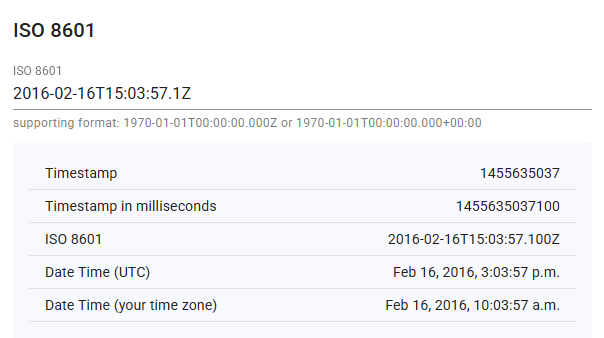
For this second scenario - using the same time via the ISO8601 API - this is what I get:
testTime (Time::fromISO8601 ("2016-02-16T15:03:57.1Z"));
0
1969-12-31T19:00:00.000-05:00
31 Dec 1969 19:00:00
19
ISTM that the milliseconds parsing is what’s broken, specifically the fact that 3 digits appear required for millis by the API even though ISO8601 supports varied amounts of digits.
        if (*t == '.' || *t == ',')
        {
            ++t;
            milliseconds = parseFixedSizeIntAndSkip (t, 3, 0);

            if (milliseconds < 0)
                return {};
        }
Both should be the same time. Here’s some supporting external validation: